
The home loan top-up, a kind of secured multipurpose personal loan, is on the regulator's radar, points out Tamal Bandyopadhyay.

Unlike any other national asset, which is typically sold to the highest bidder, the profile of the bidder is the most important criterion for a licence to bank, and even for acquiring more than 5 per cent stake, explains Tamal Bandyopadhyay.

Companies, which missed out on listing earlier, are giving it another shot but with significantly-reduced issue sizes. In the recent past, companies such as TVS Supply Chain Solutions, Suraj Estate Developers, and ESAF Small Finance Bank have re-filed their draft red herring prospectuses (DRHPs) with the Securities and Exchange Board of India (Sebi). This came after they slashed their issue sizes by 20-60 per cent.

Why do we need a bad bank, owned by the banks themselves when there are at least 28 ARCs around, asks Tamal Bandyopadhyay.

One smells a rat when cases are settled for too small a price offered either by the highest bidder or the promoter -- within and outside the legal ambit of insolvency process, observes Tamal Bandyopadhyay.

'Some of the astounding proposals, if translated into statutory provisions, would be suicidal.' 'This would not be a wonder cure for increasing insurance penetration and only result in mushrooming growth of players like paan kiosks with deleterious consequences.'

'It's a toss-up between a fire sale of equity or merger with a strong bank,' points out Tamal Bandyopadhyay.

The bulk of an investor's portfolio should be in shorter-duration funds of up to one year portfolio duration.

Bankers need to take a call on whether they will allow technology firms to run banks or banks themselves will turn into tech firms, says Tamal Bandyopadhyay.

Private equity (PE) is set to play a bigger role in banks. Of 21 recommendations accepted by the Reserve Bank of India (RBI) out of 31 made by its Internal Working Group (IWG), its stance on non-promoter holdings in private banks is seen with excitement, though it doesn't refer to PEs explicitly. On non-promoter holdings in these banks, the RBI said this will be capped at 10 per cent of the paid-up voting equity share capital in the case "of natural persons and non-financial institutions and entities"; and "at 15 per cent for all categories of financial institutions, entities, supranational institutions, public sector undertaking, or the government." While this is a modification of the IWG's stance for the non-promoter holding in banks at up to 15 per cent, it does open up a huge window for PEs, all the same. This is because, while the RBI has remained silent on the eligibility of industrial houses for bank licences, fresh high-quality capital in large amounts can only come from PEs.

'There will be 200 ITIs developed as hubs, while 800 will be developed as spoke, connected with five National Skill Training Institutes.'

'Real estate loans are given in the garb of retail loans, sourcing money cheap from the NHB refinance window.' 'This loophole is being plugged,' notes Tamal Bandyopadhyay.

The Indian financial system's asset quality improved despite the pandemic, but it could be due to special dispensations by the regulator, and banks would likely see increased stress on their books once the schemes expire. According to the annual trend and progress report of the Reserve Bank of India (RBI) released on Tuesday, the data available for this financial year so far indicate that banks' bad debts have moderated while provision coverage ratios (PCRs), capital buffers as well as profitability indicators have improved relative to pre-pandemic levels.

'The dakiyas will be our partners, receiving credit proposals from micro-enterprises at the grassroots level.'

Longer-tenure FDs generally give higher returns. Nonetheless, going for a tenure higher than two to three years is not advisable.

'We may bite the bullet and draw up plans for privatisation.' 'If that is done now, the sale of the government stake will fetch money; a delay will see erosion in whatever value is left in these banks,' says Tamal Bandyopadhyay.

Of the three major Budget announcements related to the banking sector, privatisation of PSBs is the most audacious, says Tamal Bandyopadhyay.

From the outcome of the general elections and then Union Budget to tepid corporate earnings in the September 2024 quarter (Q2-FY25), sticky inflation and Reserve Bank of India's stance on interest rates, extreme weather conditions, Indian stock markets have braved it all in calendar year 2024.
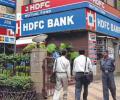
But there are challenges, observes Tamal Bandyopadhyay.

The recent run on the US-based Silicon Valley Bank (SVB) and the subsequent seizure of its assets by the regulators may have sparked a global wave of risk aversion, particularly for start-ups. However, the Indian banking sector is unlikely to be a victim of any contagion effects, said analysts. he bank, which played a big role in financing start-ups and technology players, faced stress after incurring huge losses on its holdings of US bonds, following the most-aggressive monetary tightening cycle by the Federal Reserve in around four decades.

Ask rediffGURU and PF and MF expert Janak Patel your mutual fund and personal finance-related questions.

The definition will be revised by raising capital base to Rs 2 crore from the current limit of Rs 50 lakh.

Fresh plans of privatisation or divestment in central public sector enterprises and public sector banks might take a back seat this financial year because these may require a large consensus among coalition partners.

Ask rediffGURU and PF expert Nitin Narkhede your mutual fund and personal finance-related questions.

What stood out in his 15-year journey as a member of the political executive at the Centre was his glowing record as India's most successful and effective finance minister. Both as prime minister and finance minister, he understood the importance of gradualism, except when the economy or the polity was in a crisis.

That's the only way to convince those who have money to return to the bank fold, ditching other asset classes, says Tamal Bandyopadhyay.

For non-banks, the IL&FS crisis was nothing short of India's Lehman moment, which has for a foreseeable future reset the sector on multiple grounds.

Recently, Slice, a payment app, acquired a 5 per cent stake in North East Small Finance (NESF) for $3.42 million - the first such deal by a fintech in a small finance bank. Slice (valued at $1.5 billion, and backed by Tiger Global, Blume Ventures and Axis Bank) will technically get a toehold in a scheduled commercial bank if NESF were to get a licence to morph into one down the line Such a transition is well within the banking regulator's declared framework. The transaction has to be seen in a larger context.

In the June quarter of FY24, 51 per cent of consumers who took small-ticket personal loans already had more than four credit products at the time of accessing yet another new loan, compared with just 17 per cent in the June quarter of FY20, points out Tamal Bandyopadhyay.

Banking secot to see major changes by 2020.

The Reserve Bank on Friday accepted most of the recommendations of its working group on corporate ownership of private sector banks, by allowing unrestrained promoter shareholding in the first five years of operations and hiking the same to 26 per cent after 15 years from the extant 15 per cent and also the new capital requirements. The move will benefit leading banks like Kotak Mahindra Bank and IndusInd Bank, among others, which have been seeking more time from the regulator to divest their stakes for many years now. Accepting 21 of the 33 recommendations of the internal working group, the central bank said the remaining suggestions are under its consideration.

Union Finance Minister Nirmala Sitharaman, along with her team of bureaucrats, delved into the fine print of the 2024-25 Budget documents in a press conference, detailing the government's road map on bringing down the debt-to-GDP ratio and bold tax measures.

Retail investors now own a bigger slice of smallcap companies than at the start of 2023-24 (FY24), underscoring their growing conviction about investing in this red-hot space. Data from Capitaline shows mutual funds' (MFs') average holding in the National Stock Exchange Nifty Smallcap 250 rising to 9.26 per cent from 8.67 per cent during the first six months of FY24, with the number of companies with over 20 per cent MF holdings increasing from 24 to 28. In comparison, MF holdings in Nifty50 companies have gone up only marginally, from 9.67 per cent to 9.75 per cent.
We'll need to wait a couple of years to see how many restructured loans turn bad and whether some banks fall victim to their obsession for growth, explains Tamal Bandyopadhyay.

The monthly Rs 2500 payment for poor women is expected to cost Rs 11,000 crore while the pension scheme of Rs 2000 for every senior citizen will cost around Rs 4100 crore. The Yamuna clean up will cost over Rs 10,000 crore while a similar amount is required to upgrade Delhi's hospitals. Ultimately, the new BJP government will have no choice but to ask the centre for financial support, notes Rashme Sehgal.

'Maharashtra is virtually in a debt trap.'

'Space out when raising funds; Sebi mulls securitisation platform'

Despite a shaky Q3, conviction over the stock remained high, with 65 per cent of the analysts polled on Bloomberg retaining their 'buy' recommendation.

Merely bringing down the government stake below 51% may not find any taker for the PSBs. The government must bring down its holding to at least 26%, recommends Tamal Bandyopadhyay.

What connects P S Jayakumar of Bank of Baroda, V Vaidyanathan of Capital First Ltd and Chandra Shekhar Ghosh of Bandhan?
 © 2026 Rediff.com - Advertise with us - Disclaimer - Privacy Policy - Sitemap - Feedback - About us - Terms of use - Grievances